Operationalising constructs, defending a methodology to an ethics board, running the right statistical test on messy real data — this is where most students get stuck. Our psychology-postgraduate writers take you from a vague interest to a defensible, examiner-ready dissertation.
HelpForThesis provides chapter-level and full psychology dissertation writing support - topic refinement, BPS/IRB-style ethics applications, SPSS/R/JASP quantitative analysis, NVivo qualitative coding (thematic analysis, IPA, grounded theory), and APA 7th-edition writing from introduction through discussion, for undergraduate, Master's, and PhD students.
An extended, independently conducted piece of empirical or review-based research that demonstrates your ability to design a study, collect or source data, analyse it appropriately, and interpret findings within existing psychological theory. Length and expectations vary by level and country, though some universities use "dissertation" and "thesis" interchangeably; the structural expectations stay broadly consistent either way.
| Level | Typical length | Core expectation |
|---|---|---|
| Undergraduate (BSc) | 8,000–12,000 words | An original, small-scale empirical or systematic-review study demonstrating basic research competence. |
| Master's (MSc) | 15,000–20,000 words | A more sophisticated design, stronger statistical or qualitative rigour, deeper theoretical engagement. |
| PhD / Doctoral thesis | 60,000–100,000+ words across multiple studies | An original, publishable contribution to psychological knowledge, often across 3–5 linked studies or papers. |
Most students who come to us aren't looking for someone to "do the whole thing" out of laziness — they're stuck on one specific, genuinely difficult part of the process.
We narrow a vague idea into a measurable, theory-grounded hypothesis with clearly defined independent and dependent variables — the kind of question your supervisor will approve.
We build a complete ethics submission — information sheet, consent form, debrief script, risk assessment — aligned with BPS (UK), APA (US), or your university's IRB requirements.
We select the correct test for your design, check assumptions, run the analysis, and explain the output in plain language so you can defend every number in your viva.
We structure coding in NVivo and develop themes systematically using Braun and Clarke's six-phase approach, IPA, or grounded theory, with a transparent audit trail.
Every dissertation is written from your data and brief — never resold, never AI-generated boilerplate. You receive a similarity report and an optional AI-authenticity check.
Many students commission just the methodology or results chapter and write the rest themselves — chapter-level work is priced and delivered separately.
Each sub-field has its own theoretical toolkit, standard measures, and analytical conventions. We match your interest area to the right specialist and framework.
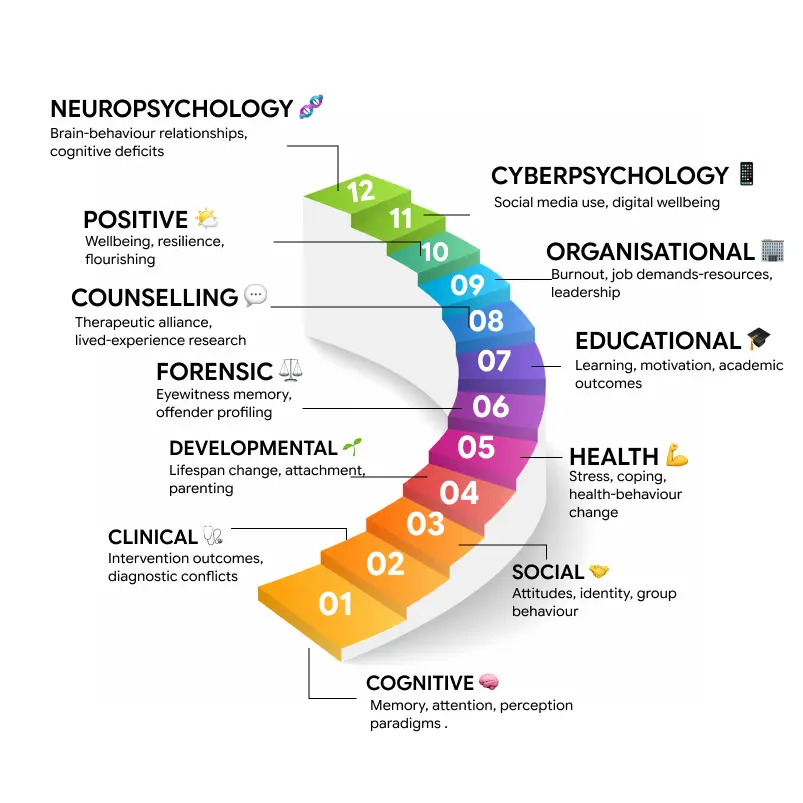
| Sub-discipline | Common focus areas | Typical theories & tools |
|---|---|---|
| Clinical psychology | Anxiety, depression, intervention efficacy, CBT outcomes | PHQ-9, GAD-7, DASS-21, BDI, within strict ethical governance |
| Cognitive psychology | Memory, attention, perception, decision-making | Reaction-time paradigms, eye-tracking, cognitive load theory |
| Social psychology | Attitudes, conformity, prejudice, group behaviour | Theory of Planned Behaviour, Social Identity Theory |
| Developmental psychology | Attachment, child cognitive development, adolescence | Bowlby, Piaget, Vygotsky; longitudinal or observational designs |
| Forensic psychology | Offending behaviour, eyewitness reliability, risk assessment | Mixed methods, careful handling of vulnerable/incarcerated samples |
| Health psychology | Health behaviour change, stress, treatment adherence | Health Belief Model, COM-B, Transtheoretical Model |
| Educational psychology | Motivation, learning difficulties, classroom interventions | Self-Determination Theory, intervention-based designs |
| Counselling psychology | Therapeutic process, client experience | IPA, strong reflexivity and ethical containment |
| Positive psychology | Wellbeing, resilience, flourishing | PERMA framework, WEMWBS, strengths inventories |
| Organisational / I-O psychology | Workplace wellbeing, leadership, burnout | Job Demands-Resources model, regression/SEM |
| Cyberpsychology | Social media use, online behaviour, digital wellbeing | Survey-based and behavioural-data designs |
| Neuropsychology | Brain-behaviour relationships, cognitive deficits | Standardised assessment batteries, neuroimaging datasets |
Focus: Anxiety, depression, intervention efficacy, CBT outcomes
Theories & tools: PHQ-9, GAD-7, DASS-21, BDI, within strict ethical governance
Focus: Memory, attention, perception, decision-making
Theories & tools: Reaction-time paradigms, eye-tracking, cognitive load theory
Focus: Attitudes, conformity, prejudice, group behaviour
Theories & tools: Theory of Planned Behaviour, Social Identity Theory
Focus: Attachment, child cognitive development, adolescence
Theories & tools: Bowlby, Piaget, Vygotsky; longitudinal or observational designs
Focus: Offending behaviour, eyewitness reliability, risk assessment
Theories & tools: Mixed methods, careful handling of vulnerable/incarcerated samples
Focus: Health behaviour change, stress, treatment adherence
Theories & tools: Health Belief Model, COM-B, Transtheoretical Model
Focus: Motivation, learning difficulties, classroom interventions
Theories & tools: Self-Determination Theory, intervention-based designs
Focus: Therapeutic process, client experience
Theories & tools: IPA, strong reflexivity and ethical containment
Focus: Wellbeing, resilience, flourishing
Theories & tools: PERMA framework, WEMWBS, strengths inventories
Focus: Workplace wellbeing, leadership, burnout
Theories & tools: Job Demands-Resources model, regression/SEM
Focus: Social media use, online behaviour, digital wellbeing
Theories & tools: Survey-based and behavioural-data designs
Focus: Brain-behaviour relationships, cognitive deficits
Theories & tools: Standardised assessment batteries, neuroimaging datasets
A workable psychology dissertation topic needs to satisfy four things at once, and most weak proposals fail on at least one.
Not just "no one has studied this," but a gap your supervisor and examiner will recognise as meaningful.
You can realistically recruit the sample, access the tools, and finish within your timeframe.
Sensitive populations or manipulations need proportionate safeguards, not just good intentions.
Every construct — stress, motivation, resilience — needs a validated way to operationalise it.
Not off-the-shelf titles to copy — illustrations of how a broad interest becomes a measurable question.
The effect of social comparison orientation on adolescent self-esteem, mediated by screen-time duration
Mindfulness-based stress reduction and cortisol reactivity in university students under exam pressure
Attachment style as a predictor of relationship satisfaction in early adulthood
Eyewitness memory accuracy under high- versus low-stress recall conditions
The role of self-efficacy in academic procrastination among first-generation undergraduates
Workplace burnout and job demands-resources balance in frontline healthcare staff
A thematic analysis of lived experience among informal carers of dementia patients
Cognitive-behavioural intervention outcomes for health-anxiety in primary care settings
Cross-cultural differences in help-seeking attitudes toward mental health services
The impact of parental attachment style on adolescent emotion-regulation strategies
If your idea is still at the "I'm interested in X" stage, that's exactly where our topic-refinement support starts.
Built around the actual chapter structure examiners expect. Commission the full package, or any single chapter.
| Chapter | What we deliver |
|---|---|
| Topic & Research Question | A refined, feasible, theory-grounded hypothesis with clearly operationalised variables. |
| Introduction | Context-setting, rationale, aims, objectives, and hypotheses framed against real psychological theory. |
| Literature Review | Critical synthesis (not a summary) of peer-reviewed sources from PsycINFO, Scopus, and PubMed, identifying a genuine gap. |
| Methodology | Justified research design, sampling strategy, validated measures/scales, ethical safeguards, and — for quantitative work — an a priori power analysis. |
| Data Collection Support | Questionnaire/survey design, Likert-scale construction, pilot testing, and reliability checks (Cronbach's alpha). |
| Results & Analysis | SPSS/R/JASP statistical output (t-tests, ANOVA, regression, correlation, mediation) or NVivo qualitative coding, reported in APA 7 tables and figures. |
| Discussion | Interpretation against the literature, alternative explanations, limitations, and theoretical/practical implications. |
| Formatting & Referencing | Full APA 7 formatting (or Harvard/MLA/your university's house style), reference list, appendices. |
| Editing & Proofreading | Line-by-line language, structure, and argument-flow editing. |
| Originality Assurance | Turnitin-style similarity report and AI-content authenticity check. |
A refined, feasible, theory-grounded hypothesis with clearly operationalised variables.
Context-setting, rationale, aims, objectives, and hypotheses framed against real psychological theory.
Critical synthesis (not a summary) of peer-reviewed sources from PsycINFO, Scopus, and PubMed, identifying a genuine gap.
Justified research design, sampling strategy, validated measures/scales, ethical safeguards, and — for quantitative work — an a priori power analysis.
Questionnaire/survey design, Likert-scale construction, pilot testing, and reliability checks (Cronbach's alpha).
SPSS/R/JASP statistical output (t-tests, ANOVA, regression, correlation, mediation) or NVivo qualitative coding, reported in APA 7 tables and figures.
Interpretation against the literature, alternative explanations, limitations, and theoretical/practical implications.
Full APA 7 formatting (or Harvard/MLA/your university's house style), reference list, appendices.
Line-by-line language, structure, and argument-flow editing.
Turnitin-style similarity report and AI-content authenticity check.
One of the most common early-stage questions we get is simply: quantitative or qualitative? Here's a fast way to think about it.
| If your research question asks… | You probably need… | Typical tools we use |
|---|---|---|
| "Does X cause/predict/correlate with Y?" | A quantitative experimental or correlational design | SPSS, JASP, R — t-tests, ANOVA, regression, correlation |
| "How do people experience or make sense of X?" | A qualitative design (IPA, thematic analysis) | NVivo — coding, theme development, reflexivity statements |
| "What patterns exist across a large existing dataset?" | Secondary data analysis | SPSS/R on datasets like UKHLS, NHANES, or your supervisor's dataset |
| "I want breadth and depth together" | A mixed-methods design | Sequential or convergent quant + qual, triangulated in the discussion |
| "I'm not collecting new data at all" | A systematic review or meta-analysis | PRISMA-guided review, sometimes with meta-analytic software |
You probably need
A quantitative experimental or correlational design
Typical tools we use
SPSS, JASP, R — t-tests, ANOVA, regression, correlation
You probably need
A qualitative design (IPA, thematic analysis)
Typical tools we use
NVivo — coding, theme development, reflexivity statements
You probably need
Secondary data analysis
Typical tools we use
SPSS/R on datasets like UKHLS, NHANES, or your supervisor's dataset
You probably need
A mixed-methods design
Typical tools we use
Sequential or convergent quant + qual, triangulated in the discussion
You probably need
A systematic review or meta-analysis
Typical tools we use
PRISMA-guided review, sometimes with meta-analytic software
If you're still unsure, that's normal — this is exactly the kind of decision our writers help you make in the proposal stage, based on your timeframe, ethics constraints, and available population.
Examiners look for a specific logical thread running through every chapter — not just correct formatting. Here's the structure we build every dissertation around, and why each part matters.
A precise, searchable title and a 250–300 word summary covering aim, method, key finding, and implication.
Sets up the "why should anyone care" case, ending in explicit research questions or hypotheses.
Argues a position rather than listing studies chronologically, and should end by pointing directly at your gap.
Design, participants/sampling, materials/measures (with reliability data), procedure, ethical considerations, and — for quantitative work — planned analysis and power calculation.
Descriptive statistics first, then inferential results reported in APA 7 style, or qualitative themes with illustrative extracts.
Interpret, don't just restate. Compare to the literature, address limitations honestly, and state real theoretical/practical implications.
Full APA 7 reference list; raw materials, consent forms, and additional output in appendices.
This is also the order in which we can support you chapter-by-chapter if you'd rather write parts of it yourself and bring us in for the sections you're stuck on.
Data analysis is where most psychology dissertations either earn a first-class mark or lose one. We match the approach to your research question — never the other way round.
t-tests, ANOVA/ANCOVA, regression, correlation, chi-square, and mediation/moderation in SPSS, R, or JASP — with assumption checks (normality, homogeneity of variance, sphericity) and APA 7-formatted tables.
Thematic Analysis (Braun & Clarke six-phase), IPA, Grounded Theory, and Framework Analysis — coded systematically in NVivo with a documented audit trail.
PHQ-9, GAD-7, DASS-21, Beck Depression/Anxiety Inventories, State-Trait Anxiety Inventory, Rosenberg Self-Esteem Scale, Big Five Inventory, WEMWBS, PANAS — each with a documented Cronbach's alpha check.
That's a normal place to start — this is exactly the decision our writers help you make at the proposal stage, based on your timeframe, ethics constraints, and available population. See proposal writing help →
Every statistical output comes with a plain-language explanation, so when your supervisor asks "why did you choose ANOVA over a t-test here?" — you have a confident answer, not a guess.
| Research objective | Statistical test | Software |
|---|---|---|
| Compare two groups | Independent/paired t-test | SPSS, JASP |
| Compare 3+ groups | ANOVA / ANCOVA | SPSS, R |
| Relationship between variables | Correlation | SPSS, JASP |
| Predict an outcome | Multiple regression | SPSS, R |
| Categorical relationships | Chi-square | SPSS |
| Mediating/moderating effects | Mediation/moderation modelling, SEM | R, AMOS |
Statistical test: Independent/paired t-test
Software: SPSS, JASP
Statistical test: ANOVA / ANCOVA
Software: SPSS, R
Statistical test: Correlation
Software: SPSS, JASP
Statistical test: Multiple regression
Software: SPSS, R
Statistical test: Chi-square
Software: SPSS
Statistical test: Mediation/moderation modelling, SEM
Software: R, AMOS
How it works
A genuine sequence — each stage builds on the last, so there are no surprises once writing begins.
Topic, module handbook, deadline, supervisor feedback
A specialist in your sub-discipline & software
Methodology & measures agreed before writing starts
Reviewed in stages, not one block at the end
Until it matches your marking criteria
Similarity report, APA 7 formatting, output files
Topic, module handbook, deadline, supervisor feedback
A specialist in your sub-discipline & software
Methodology & measures agreed before writing starts
Reviewed in stages, not one block at the end
Until it matches your marking criteria
Similarity report, APA 7 formatting, output files
No vague "contact us for pricing" games. Costs genuinely vary by academic level, deadline, and whether you need a chapter or a full dissertation — here's a realistic starting range.
$12–$18 / page
$450–$1,400 full project
$1,600–$2,500+ full project
Ranges shown are indicative starting estimates based on academic level and standard (14–20 day) turnaround; rush deadlines increase per-page rates. Share your brief for an exact, free, no-obligation quote — you'll know the final cost before committing to anything.
No vague "contact us for pricing" games — here are the real factors that move the number.
| Factor | Why it matters |
|---|---|
| Academic level | PhD-level statistical and theoretical rigour costs more writer-hours than undergraduate work. |
| Scope | A single chapter costs less than a full dissertation with data collection support. |
| Deadline | Rush turnarounds (under 7 days) carry a premium over standard 3–4 week timelines. |
| Analysis complexity | SEM/mediation modelling or large-scale NVivo coding takes more specialist time than a simple t-test. |
| Data collection support | Designing and piloting a new questionnaire adds scope beyond writing alone. |
PhD-level statistical and theoretical rigour costs more writer-hours than undergraduate work.
A single chapter costs less than a full dissertation with data collection support.
Rush turnarounds (under 7 days) carry a premium over standard 3–4 week timelines.
SEM/mediation modelling or large-scale NVivo coding takes more specialist time than a simple t-test.
Designing and piloting a new questionnaire adds scope beyond writing alone.
Why HelpForThesis
Every dissertation is handled by someone with an actual Master's or PhD in Psychology.
Our writers run SPSS, R, JASP, and NVivo daily — not just cite them.
BPS-aligned (UK) or IRB-style (US/international) documentation as standard.
Written from scratch, backed by a similarity report; AI-authenticity checks on request.
No relay-through-support-agent delays on methodology or data questions.
Your data, personal details, and order history are never shared or resold.
Student outcomes
Stuck on the methodology chapter — didn't know how to justify sample size or which test to run. My writer walked me through the design before starting, and the SPSS output section was exactly what my supervisor wanted.
35 interview transcripts and genuinely no plan. The thematic analysis support turned that pile of data into a coherent, examiner-ready results chapter with a proper audit trail.
My ethics application was rejected twice. It was rebuilt around BPS guidelines and approved on the first resubmission.
Anonymised excerpts showing exactly how we operationalise variables, justify validated scales, report statistical or NVivo output to APA standard, and build a genuinely critical discussion — mocked up here to give you a feel for the format before you request full sample chapters.
| Levene's F | Sig. | t | df | p (2-tailed) | Mean diff. | |
|---|---|---|---|---|---|---|
| Equal variances assumed | 1.842 | .178 | −3.216 | 78 | .002 | −4.35 |
| Equal variances not assumed | — | — | −3.201 | 74.6 | .002 | −4.35 |
Cohen's d = 0.72 (medium–large effect). Reported in APA 7 table format with assumption checks noted above the output.
SPSS output reformatted into an APA 7 table, with the assumption check and effect size a supervisor will look for.
Supervisor comment
Good — this links back to your H1 cleanly. Consider adding the Bandura citation here.
Chapter-by-chapter delivery means feedback like this gets folded in before the next section is written, not after.
Braun & Clarke six-phase coding with a transparent, referenceable audit trail — not just a list of theme names.
Every delivered document ships with a similarity report, and an AI-authenticity check is available on request — so you know what you're submitting before your supervisor sees it.
A low similarity score mostly reflects properly quoted/cited material and reference-list matches, not copied content.
We can share anonymised sample psychology dissertation chapters — including an undergraduate example, a Master's results/discussion chapter with full SPSS output, and a qualitative thematic-analysis sample.
Start by narrowing a broad interest into a measurable question, then work backward: what population, what measure, what analysis would answer it? Most students benefit from a structured proposal stage before writing the introduction — this is exactly what our topic and proposal support is designed for.
Yes. Many students commission only the methodology or results/analysis chapter and write the rest themselves. Chapter-level support is priced separately from full-dissertation packages.
Yes — we can share anonymised APA 7-formatted sample chapters, including undergraduate psychology dissertation examples, on request before you place an order.
Yes. We build studies around BPS Code of Human Research Ethics (UK institutions) or standard IRB expectations (US and international institutions), covering informed consent, right to withdraw, confidentiality, debriefing, and proportionate risk assessment for sensitive populations.
Yes. We conduct descriptive and inferential analysis in SPSS, R, or JASP — t-tests, ANOVA, regression, correlation, chi-square, and mediation/moderation — with assumption checks, effect sizes, and APA 7-formatted tables you can confidently explain in a viva or defence.
Yes. We deliver thematic analysis, IPA, and grounded theory using NVivo, with transparent coding frameworks, theme development, and reflexivity statements that meet the rigour qualitative examiners expect.
Chapter-level support typically runs $12–$28 per page depending on academic level and deadline. Full dissertation packages range from roughly $450 for a Master's project to $2,500+ for a complete PhD-level dissertation. You'll get a free, no-obligation quote after sharing your brief.
Entirely. Your project is written from scratch for you alone, never resold or reused, and supported by a similarity report. All communication and personal data remain confidential throughout.
We take on rush orders down to a few days for single chapters, though full dissertations need realistic lead time for proper research and analysis — we'll be upfront if a deadline isn't achievable rather than promising something we can't deliver.
Yes. We analyse secondary data such as institutional datasets, open psychology repositories, or your supervisor's existing dataset, documenting variable selection, cleaning, and analysis transparently.
Psychology dissertations require operationalising psychological constructs into measurable variables, justifying validated psychometric scales, meeting BPS/APA/IRB ethical standards specific to human-participant research, and correctly applying psychology-specific statistical or qualitative methods — general academic writers without a psychology background typically can't do this credibly.
"Dissertation" and "thesis" are often used interchangeably depending on your country and university — both refer to the extended independent research project required for your degree. A research paper is typically shorter and aimed at journal publication rather than degree completion, though PhD dissertations increasingly combine both formats.
Yes — topic and research-question refinement is usually the very first stage of our process, well before any writing begins.
Every stage of the dissertation journey, covered separately if that's all you need.
Share your topic, deadline, and university guidelines, and we'll match you with a psychology dissertation specialist within hours — with a free, no-obligation quote before you commit to anything.