Last updated:
| Service | Scopus Paper Writing as per Journal Guidelines |
| Suitable for | PhD scholars, M.Tech and Master's students, faculty, independent researchers |
| Subject areas | Computer science and IT, electronics and communication, mechanical/civil/electrical engineering, life sciences, business and management, education and other research domains |
| Reference styles | APA, MLA, IEEE, Chicago, Harvard, or your university format |
| Delivery | Typically 6-10 working days; express delivery on request |
| Revisions | Unlimited until you are satisfied |
| Plagiarism report | Provided on request |
| Confidentiality | Your data, research and identity are never shared with third parties |
| Contact | +91 7200035629 · WhatsApp |
If you're preparing a manuscript for a Scopus-indexed source, the quality of your writing matters as much as the quality of your research. Our Scopus paper writing services help researchers develop, structure and refine manuscripts — from literature review through discussion and formatting — so the work is presented clearly, accurately and in line with academic expectations.
Research Domains Supported
Specialized Manuscript Services
Citation Styles Formatted
Confidential & Originality-Checked

Scopus paper writing services are professional support for developing, editing and formatting a research manuscript intended for a Scopus-indexed journal or conference — covering everything from literature review synthesis to citation formatting. Scopus itself is a citation database maintained by Elsevier; it doesn't publish papers or apply a special format — requirements come from your target journal or conference.
A quick summary before you read the full page.
| What it is | Manuscript writing, editing and formatting support for research intended for Scopus-indexed journals and conferences. |
|---|---|
| Who it's for | PhD scholars, postgraduate researchers, faculty and independent researchers across disciplines. |
| What's covered | Literature review , methodology , results & discussion, technical editing, proofreading, citation formatting, manuscript formatting, originality checks. |
| Citation styles | APA, IEEE, Vancouver and other styles as required by your target source. |
| Turnaround | Depends on manuscript scope and section count — confirmed at quote stage. |
| Pricing | Custom quote based on discipline, length and deadline — see indicative ranges below. |
| What we don't do | We do not fabricate data, guarantee acceptance, or provide journal-submission services. |
Exact pricing depends on discipline, manuscript length, current draft stage and deadline. These tiers are indicative starting points — request a free quote for an exact figure.
e.g. Literature review , or methodology chapter · Indicative India market range for a single manuscript section
2–4 sections, e.g. intro + methodology + results · Indicative India market range for multi-section development
Complete manuscript, built around your findings · Indicative India market range for complete manuscript development
Prices vary by research domain, current manuscript stage and required turnaround. Share your requirement in the form above for a transparent, no-obligation quote.
Indicative market ranges in India as of September 2026; actual Help For Thesis pricing may vary by research domain, manuscript stage, word count, technical complexity and turnaround. Publicly listed Indian research-support prices currently span roughly ₹10,000–₹50,000 for manuscript writing and around ₹40,000–₹45,000 for some complete manuscript packages.
Market-reference note: These price ranges are indicative market estimates based on publicly available pricing information for academic research and manuscript-writing services in India during 2026. They are provided for general guidance only and do not represent a fixed tariff or official pricing of Help For Thesis. Actual service costs may vary depending on the research discipline, manuscript length, complexity, current manuscript stage, and required turnaround time.
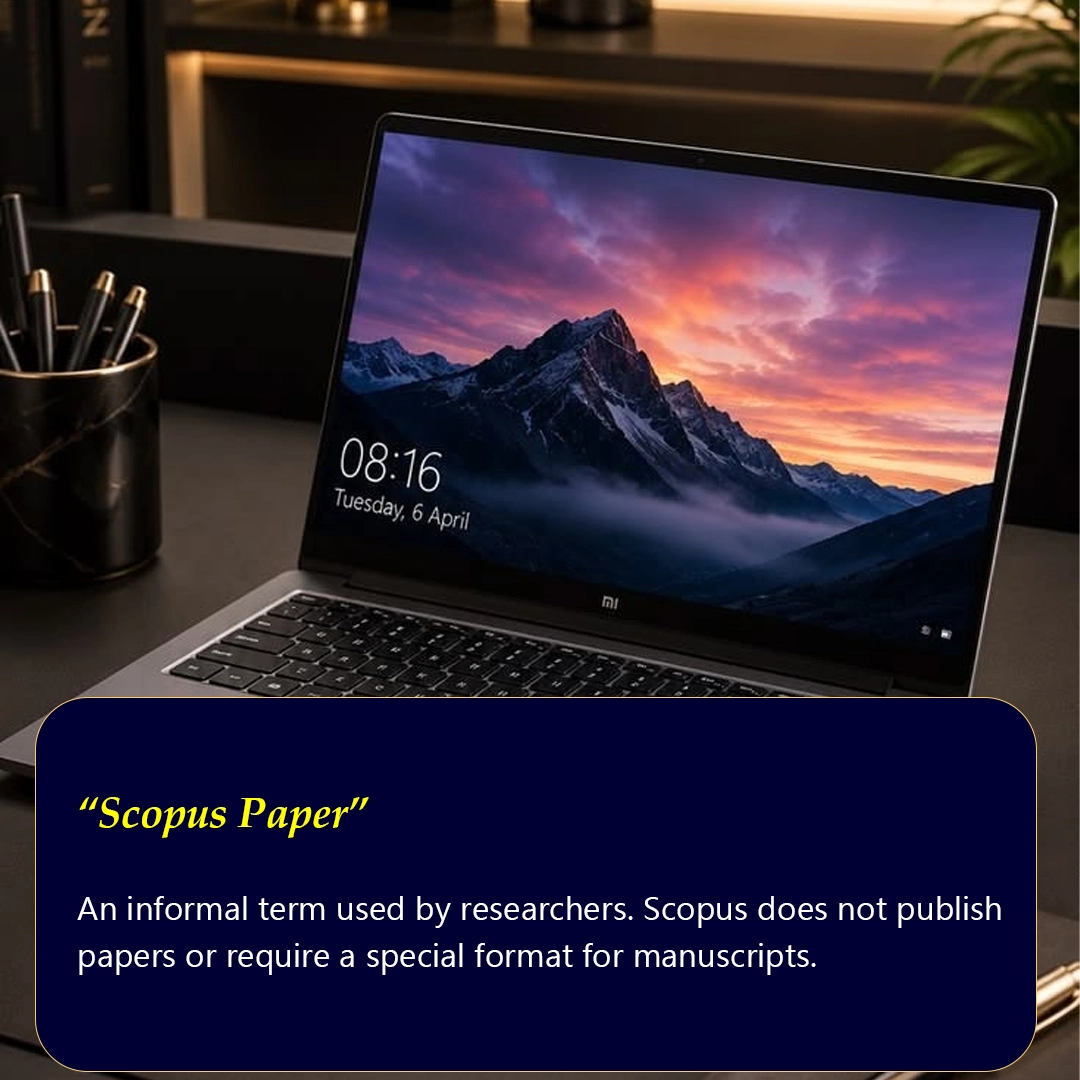
Scopus is an abstract and citation database, maintained by Elsevier, that indexes journals, conference proceedings and other scholarly sources based on defined selection criteria. A journal, conference or book series is either included in Scopus's index or it isn't — that's what "Scopus-indexed" means.
When researchers say "Scopus paper," they typically mean a research article written for, or published in, a Scopus-indexed source. The paper itself doesn't have a special "Scopus format" — its structure, style and requirements come from the journal or conference it's submitted to, not from Scopus. Indexing status describes the relationship between the source and the database, not a format applied to individual articles.
This also answers a related question researchers ask — what is Scopus citation? It refers to how a published work is referenced and tracked inside the Scopus database, and to the reference style your manuscript must follow for its target journal. Understanding this distinction matters: there is no single universal "Scopus paper template." What matters is writing a well-structured, evidence-based manuscript that meets the standards of your chosen source and discipline.
Strong manuscripts are built step by step. Here's how the process typically works.
Start with a precise statement of the problem your research addresses. A vague or overly broad problem statement makes everything downstream harder to write clearly.
Explain what existing literature hasn't addressed, and why your study is needed.
Objectives should be specific and directly answerable by your methodology and results.
A good literature review synthesizes prior work rather than summarizing papers one by one, and builds toward your research gap logically — built directly from your Literature review .
Explain it with enough detail that another researcher could understand — and ideally replicate — your approach.
Report results objectively, with tables and figures labeled, referenced in text, and easy to interpret.
Connect your results back to the literature review and research gap — explaining what the findings mean.
Summarize contributions honestly and acknowledge limitations rather than overstating what the study proves.
Every claim that draws on prior work needs accurate, consistently formatted citations matching your target source's style.
Headings, tables, figure captions, reference style and word count should follow your target journal's author guidelines.
Most research manuscripts share a common backbone, though exact structure varies by discipline and target source.
Concisely signals the paper's focus and scope
Summarizes the problem, method, key results and contribution.
Supports discoverability and indexing.
Establishes context, problem and research gap.
Synthesizes prior research and positions your contribution.
Explains how the research was conducted.
Presents findings objectively.
Interprets findings in light of prior research.
Summarizes contribution and limitations.
Lists all cited sources in the required style.
Important: Not every discipline follows this exact IMRaD order — some fields combine results and discussion, others separate methodology into sub-sections. Your target journal's author guidelines take priority over any generic template.
For each service, you tell us the scope and provide your research materials; we deliver a written or edited section matched to your requirements, ready for your review.
Full manuscript development from your topic, data and objectives — built section by section around your findings.
Synthesis of relevant prior research into a coherent narrative that supports your research gap.
Clear framing of the research problem, context and gap, connecting naturally into your objectives.
Structured, precise explanation of your research design, data collection and analytical approach.
Clear presentation of findings and discussion writing that connects results to literature and objectives.
Line-level review for clarity, terminology consistency, logical flow and academic tone.
Grammar, syntax and language-quality review appropriate for scholarly writing.
Accurate, consistent formatting in your required style — APA, IEEE, Vancouver and others.
Formatting to match a specific journal or conference's author guidelines, including headings, tables and figures.
Originality checks to confirm the manuscript reflects your own writing and properly attributes sourced material.
Structured revisions based on your feedback or your supervisor's comments.
There is no single universal format for every manuscript submitted to a Scopus-indexed source — but most academic manuscripts share common formatting elements.
See Journal Publication SupportTitle — concise and descriptive
Abstract — typically 150–300 words
Keywords — usually 4–6 terms supporting discoverability
Headings — consistent hierarchy (H1/H2-style)
Figures & tables — labeled, numbered, referenced in text
Equations — numbered per discipline convention
References — formatted per target source's citation style
Manuscript length — varies by journal and article type
Supplementary material — occasionally required for data-heavy studies
Author-related information matters for accuracy, consistency and research visibility.
Spelled and ordered consistently across all your publications.
Your institution, department and location at the time of the research.
A persistent researcher identifier that distinguishes your work from others with similar names.
The designated contact point for editorial correspondence.
Increasingly required by journals to clarify each author's role.
How your references are formatted, and how your own work may later be cited by others.
We don't fabricate or estimate current Scopus author metric rules — such as citation counts, status or author scoring criteria. These are determined by Scopus/Elsevier directly and can change, so we help you present author information accurately rather than making claims about metrics.
Producing strong research is only half the challenge — communicating it clearly is the other half.
Converting raw findings into a coherent, well-organized manuscript
Academic English challenges, particularly for non-native English speakers.
Explaining complex methodology in a way that's understandable and replicable.
Synthesizing a large body of literature into a focused review.
Managing citations consistently across a long document
Getting technical terminology right without overcomplicating the writing
Interpreting results meaningfully rather than just restating them
Formatting a manuscript to match a specific journal's requirements.
Working under tight deadlines while balancing research or teaching duties.
These are genuine, common obstacles — not reasons to fear the process, but reasons expert writing support can meaningfully improve the outcome.
Subject-specific support
Researcher-focused collaboration
Structured writing process
Human academic review
Citation consistency
Confidentiality
Originality checks
Clear communication
Feedback-based revisions
Transparent scope
Our Process
A structured approach that keeps your research, manuscript requirements and revisions aligned from the beginning to the final draft.
Your topic, discipline and manuscript stage.
Draft, data, methodology, existing sections.
Target source guidelines, formatting, deadline.
An outline aligned to your research.
Written around your findings.
Clarity, tone, terminology.
Accuracy and consistency.
Revisions based on your input.
You can use the service for a complete manuscript, selected sections, editing an existing draft, a technical review, formatting alone, or proofreading only — the scope is flexible to your stage of work.
For transparency, here's exactly what's included, and where the line is drawn.
A structured manuscript, or edited manuscript sections
A developed literature review
A written methodology section
Refined results and discussion sections
Consistently formatted citations and references
Technically edited, proofread content
An originality/plagiarism check
A manuscript formatted to your target source's requirements
Revisions based on your agreed feedback
Fabricate research data or invent results
Create false references or manipulate findings
Guarantee acceptance by a journal
Misrepresent authorship
Provide publication guarantees
Why Help For Thesis
Practical academic support built around your research, discipline and manuscript requirements.
Across multiple disciplines and research domains.
Not template-based content. Support is shaped around your requirements.
Your research and data are handled confidentially throughout.
Every manuscript follows a clear and disciplined process.
Included as standard of Turnitin report, before delivery.
By people familiar with academic conventions and technical writing.
Clear communication is maintained throughout the project.
Based on your or your supervisor's input.
Wherever you're based.
Research problem is clearly defined
Research gap is supported by literature
Objectives are specific
Methodology is clearly explained
Data and analysis are accurately represented
Results are clearly presented
Discussion connects findings with prior research
Limitations are acknowledged
References are consistent
Citations are correctly placed
Tables and figures are labelled
Academic language has been reviewed
Manuscript formatting follows requirements
Originality/plagiarism has been checked
Author and affiliation details are consistent
Professional support for developing, editing and formatting a research manuscript intended for a Scopus-indexed journal or conference — covering everything from literature review to citation formatting.
An informal term researchers use for a manuscript written for a Scopus-indexed source. Scopus itself is a citation database, not a journal, and doesn't apply a special format to individual papers.
Start by defining your research problem and gap, then build through objectives, literature review, methodology, results, discussion and conclusion — following your target journal's specific guidelines.
Most manuscripts include a title, abstract, keywords, introduction, literature review, methodology, results, discussion, conclusion and references — though exact structure varies by discipline and source.
A Scopus citation refers to a citation of a published work that is tracked and counted in the Scopus database. Citation counts can be used in research metrics and indicators such as an author's citation profile, h-index and journal-level metrics such as CiteScore. Scopus does not prescribe a single citation or reference style for manuscripts. Citation and reference formatting requirements are determined by the specific journal or conference you are submitting to.
Citations and references should be formatted according to the specific journal or conference's author guidelines. Depending on the publication, the required style may include APA, IEEE, Vancouver, Harvard or another journal-specific format. Scopus itself does not impose a universal citation style.
Yes. We can develop a manuscript from your outline and data, or work with a partial or complete draft to improve structure, clarity and academic quality.
Yes, we offer technical editing and academic proofreading as standalone services or as part of full manuscript development.
Yes, both are core parts of our manuscript development and section-writing services.
Yes, we format citations and references consistently in the style required by your target journal or conference.
Yes, we conduct originality checks as part of our quality process.
No. Formatting requirements depend on the specific journal or conference and the academic discipline — always follow your target source's author guidelines.
Typically your research topic, objectives, existing draft (if any), data, methodology, results, references and any university or journal formatting requirements or deadlines.
Computer science, engineering, management, healthcare, life sciences, social sciences and more — see the full list above.